The UV index is not the warm sensation of sunlight on bare skin
The warmth of sunlight is not a reliable indicator of how quickly you will sunburn in a given situation. On one hand, you can still get sunburned on a cooler cloudy day, while on the other hand, the sun can feel scorching hot on your skin in the morning and yet you won't sunburn (very quickly).
You probably knew this already, but it still feels unintuitive to me. I'm going to look at numbers and think about them until I convince myself, and perhaps you, that this is true.
How does sunburn happen
Sunburn is triggered when your DNA is damaged from light absorption - in particular, UV-B (and to a limited extent, UV-A) is absorbed in a way that alters DNA's molecular structure1.
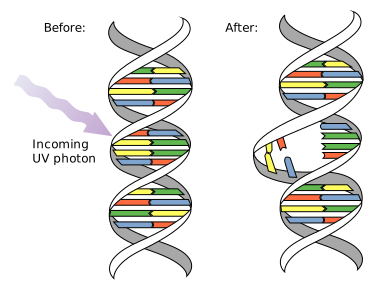
Image: DNA UV mutation by Mouagip (derivative of a NASA / David Herring original), released into the public domain.

This interferes with protein synthesis and wreaks havoc in your body over time, but the DNA damage itself is painless2.
Why does the sun feel warm
Sunlight feels warm because visible and infrared light excites vibrational modes in various molecules in your skin, especially water and melanin. For physics reasons, this is strictly a form of heating and never directly damages molecular structure.
And if you have a darker skin tone, the sun will feel warmer to you, yet you'll sunburn much more slowly.
Visible light, near-IR and mid-IR are absorbed to different degrees and at different depths of the skin, but they all contribute to that feeling of warmth.
Different mechanisms, different scales
Not only are the mechanisms completely different for sunburn and solar heating, the orders of magnitude of energy are as well.
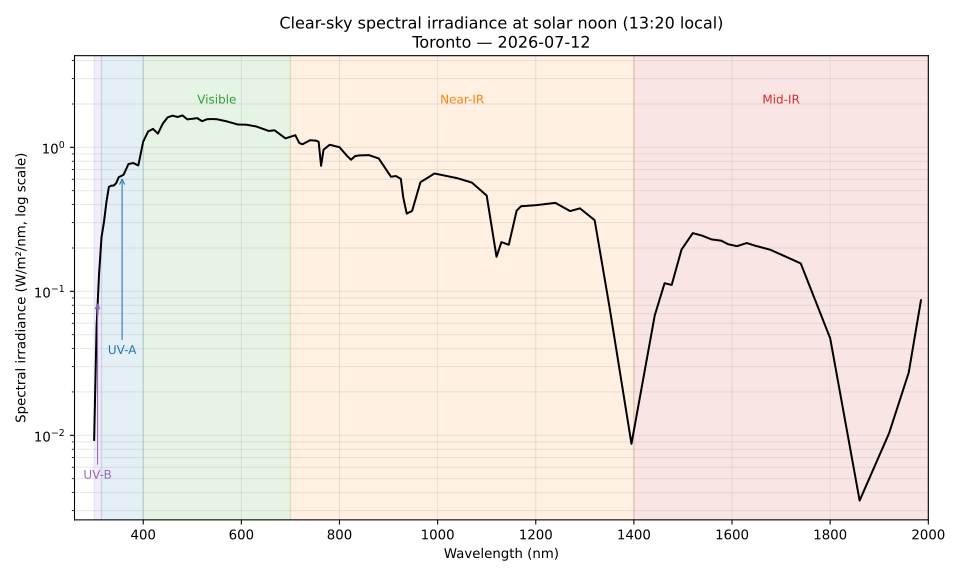
At the Earth's surface, the UV-B band is hundreds of times less intense than near-IR. Reasonably, it takes a lot more power to toast your buns (and the rest of your body) than it does to toast your DNA3.
For some reason, knowing this makes it more intuitive to me that sunlight's warmth is disconnected from the rate of sunburn. Even if you were absorbing all that UV-B as heat, the resulting warmth would be completely imperceptible.
Time of day affects UV and IR differently
The sun is by far the most intense when the sun is overhead - solar noon. This is true regardless of wavelength of light. However, UV intensity drops off more rapidly than IR as you get further away from noon, as it gets scattered more heavily by the atmosphere.
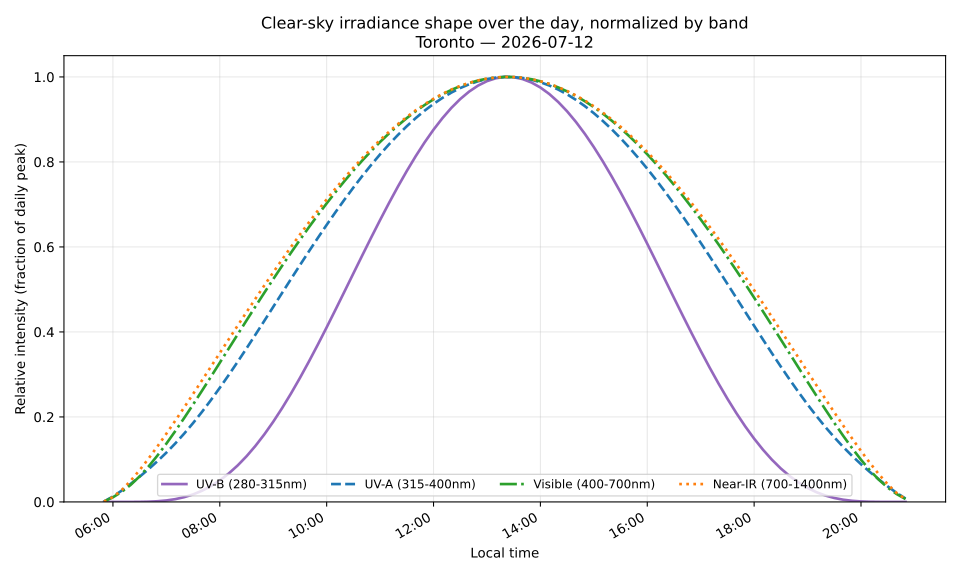
So, the sun may still feel pretty intense in the morning or late afternoon, but the risk of sunburn is considerably lower.
Wait, what about the weather?
Clouds are made of water, which scatters UV and absorbs IR. On a uniformly cloudy day, both UV index and perceived warmth from the sun drop substantially. However, if there are gaps in the clouds, it can actually amplify the UV intensity at ground level. Snow and ice contribute to this effect as well.
Where did these plots come from?
These plots are simulated measurements created using pvlib, an open-source Python library for modeling solar energy, using its implementation of the SPECTRL2 model to estimate the spectrum of sunlight reaching the ground throughout the day.
Anderson, K., Hansen, C., Holmgren, W., Jensen, A., Mikofski, M., and Driesse, A. “pvlib python: 2023 project update.” Journal of Open Source Software, 8(92), 5994, (2023). DOI: 10.21105/joss.05994.
Some caveats:
- pvlib is designed for solar panels, not human bodies
- assumes a perfectly clear sky over Toronto (43.8°N, 79.4°W) on 2026-07-12, with the sun hitting a horizontal object
- other model parameters are set to reasonable defaults and do not come from historical measurements
- SPECTRL2 cuts off at 300 nm, so UV-C and a part of UV-B are not shown